Same Cluster, Double the Score: RIT More Than Doubles Its IO500 Result with Next-Generation CLYSO Enterprise Storage
NEW YORK, Nov. 16, 2026
Press Release Disclaimer: This is a press release distributed through the XPR Media network. It has not been independently verified by our newsroom.

Same Cluster, Double the Score: RIT More Than Doubles Its IO500 Result with Next-Generation CLYSO Enterprise Storage
PR Newswire
NEW YORK, Nov. 16, 2026
Up to 7.3x faster on the shared-file and metadata work that keeps GPUs waiting: no new hardware, no proprietary client, open-source Ceph underneath
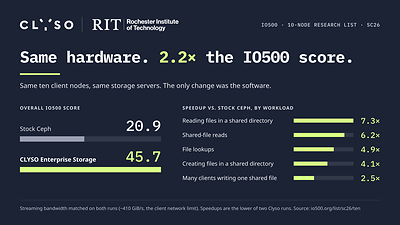
NEW YORK, Nov. 16, 2026 /PRNewswire/ — Clyso, the Ceph engineering and support company, today announced that Rochester Institute of Technology (RIT) more than doubled its IO500 score with an early version of the next generation of CLYSO Enterprise Storage, on the same hardware. RIT ran the benchmark twice from the same ten client nodes against the same storage servers, one on stock Ceph and one on the new CLYSO Enterprise Storage. The score rose from 20.9 to 45.7, 2.2 times higher, and the biggest gains came where AI and HPC jobs hurt most: many clients working on the same files and directories at once.
IO500’s 10-Node benchmark measures storage performance using a fixed set of ten compute nodes, providing a consistent comparison regardless of the underlying storage system’s size. RIT’s results go a step further: both tests used identical compute and storage hardware, with software as the only variable, demonstrating the performance gains delivered by CLYSO Enterprise Storage.
Most storage looks fast when every client works on its own files. Real training and simulation jobs don’t work that way. Data loaders open millions of small files in shared directories, and hundreds of ranks write the same checkpoint at the same moment. When the metadata layer stalls, the GPUs wait. RIT’s results show that Ceph, built and tuned by Clyso, eliminates critical storage bottlenecks delivering greater performance from existing hardware without additional infrastructure investment.
“We’ve seen measurable improvements to CephFS through our work with Clyso, particularly for AI and HPC workloads where shared-file access and metadata performance matter. We’re pleased with the results so far and look forward to continuing to improve performance together,” said Paul Mezzanini, Platform Engineer III at RIT.
Results on the same hardware, compared with stock Ceph:
- Data loading: reading files in a shared directory, 7.3x faster; file lookups, 4.9x faster.
- Checkpointing: creating files in a shared directory, 4.1x faster; many clients writing one shared file, 2.5x faster.
- Shared-file reads: 6.2x faster.
- Streaming bandwidth: about 410 GiB/s on both runs, the limit of the ten client nodes’ network.
Each figure is the lower of two Clyso runs; 45.7 is the run RIT submitted. Overall, the IO500 bandwidth score rose 2.0x and the metadata score 2.2x.
One open platform, not another silo. CLYSO Enterprise Storage is Ceph. The same cluster serves a shared POSIX file system, S3 object storage and Kubernetes volumes, including shared read-write (RWX) volumes. It uses standard Ceph clients, with nothing proprietary on the GPU nodes and no lock-in. Clyso’s engineers reworked parts of Ceph’s metadata servers, network path and storage engine, and Clyso is proposing the improvements to the open-source Ceph project.
“Teams are told they need a proprietary filesystem to keep their GPUs fed. RIT just showed otherwise: same cluster, same benchmark, and the only thing that changed was the software,” said Dan van der Ster, CTO of Clyso and co-chair of the Ceph Executive Council. “That’s open-source Ceph, built and supported by people who help lead the project.”
See it live at SC26. At booth 5206, Clyso races stock Ceph against the same next-generation CLYSO Enterprise Storage build that RIT tested, on identical clusters. Visitors can also try CLYSO FleetWatch, Clyso’s new system that monitors, alerts on, and safely patches many Ceph clusters from one place.
Availability. The next generation of CLYSO Enterprise Storage and CLYSO FleetWatch will be generally available in early 2027. Organizations can ask Clyso for a Full System Analysis of their own cluster, including the same measurements, to see what the new release would change for them.
Additional Resources:
- RIT’s submission on the IO500 10 Node Research list: https://io500.org/list/sc26/ten
- clyso.com
About Clyso. Clyso is a Ceph engineering and support company with offices in Munich, New York and Vancouver. More than 50 organizations, from national research labs to large enterprises, run Ceph with Clyso’s support, health checks and CLYSO Enterprise Storage. Clyso is among the top three code contributors to Ceph, co-chairs the Ceph Executive Council, and is one of four Diamond members of the Ceph Foundation. Learn more at clyso.com.
About RIT. Founded in 1829, Rochester Institute of Technology is a diverse and collaborative community of engaged, socially conscious, and intellectually curious minds. Through creativity and innovation, and an intentional blending of technology, the arts and design, we provide exceptional individuals with a wide range of academic opportunities, including a leading research program and an internationally recognized education for deaf and hard-of-hearing students. Beyond our main campus in Rochester, New York, RIT has international campuses in Croatia, Dubai, and Kosovo. And with more than 21,000 students and more than 159,000 graduates from all 50 states and over 100 nations, RIT is driving progress in industries and communities around the world. Find out more at rit.edu.

 View original content to download multimedia:https://www.prnewswire.com/news-releases/same-cluster-double-the-score-rit-more-than-doubles-its-io500-result-with-next-generation-clyso-enterprise-storage-302939800.html
SOURCE Clyso Inc.